I was in Montreal two weeks ago to take part in the 2012 McGill Global Food Security Conference, presenting in a session titled “Can High Food Prices and Volatility Be Managed?” Here are my slides (document opens a .pdf file).
My answer to the question posed by the session’s theme was: “Yes, but high food prices and food price volatility are different problems requiring different policy instruments,” and most of my presentation was dedicated to explaining (and then showing empirical examples of) how “food price volatility” is not the same thing as “high food prices.”
Columbia University historian Mark Lilla does a short Q&A in this week’s New York Times book review.
[T]here’s another factor, I think, and that is the centrality of economic policy to our politics today, and its inherent complexity. Though wars are complicated things, it’s not hard to develop a defensible position about their legitimacy or illegitimacy. But you need to know a fair amount about finance to make any sense, for example, of the bank collapses and bailouts of 2008-9 and the stimulus that followed. Very few people have that, but in a democracy everyone is supposed to have an opinion about everything. Everyone’s opinion is supposed to matter; you shouldn’t need higher education to chime in. But on economic policy you do. This opens the field to charlatans who demonize educated elites and reassure people that “it’s really all very simple.”
The emphasis is mine.
Though I agree that there certainly are many charlatans who demonize educated elites and have simple (and almost surely mistaken) answers to complex questions, I find that, on matters of social science, many people think they know more than they actually do (because hey, they live in society!) and are prone to dismiss experts as ideological hacks.
I wish I’d had a chance to write on this topic earlier, but travel to the West Coast for work last week and working on my research this week prevented me from taking the necessary time to read everything I could find on food prices, digest it all, and write something worth reading on the topic.
The crop season started out nicely this spring, with corn producers setting out to cultivate almost 100 million of acres of corn, the largest cultivated area in 75 years. At the beginning of summer, however, things took a turn for the worst, with many areas experiencing both drought and extreme temperature.
Worry about Extreme Temperatures, Not Drought
Before anything else, I’d like to make one thing clear: Rather than drought, it looks as though it is extreme temperature that is the problem.
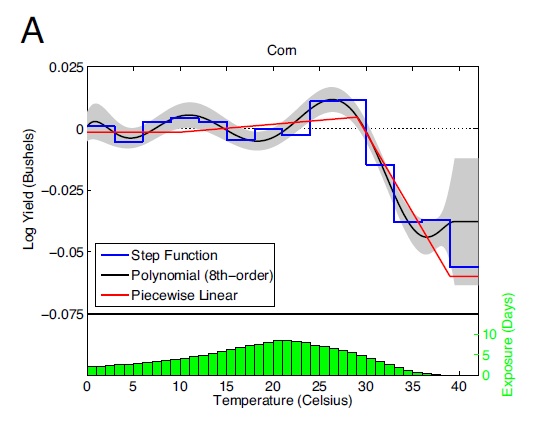
Indeed, according to my colleague Mike Roberts at NC State, drought is a poor predictor of crop yields, whereas extreme temperature — defined as the number of days for which temperature exceeds 84.2 degrees Fahrenheit — does a much better job of predicting crop yields.
The impact of temperature on crop yields looks like this (see the original research article here):
Corn Yields and Temperature (Source: Schlenker et al., PNAS 2009).
In other words, though there is a roughly linear relationship between temperature and corn yields from about 10 to about 29 degrees Celsius (i.e., from about 50 to about 84.2 degrees Fahrenheit), at which point corn yields drop sharply.
Everybody’s an Expert
Columbia University historian Mark Lilla does a short Q&A in this week’s New York Times book review.
[T]here’s another factor, I think, and that is the centrality of economic policy to our politics today, and its inherent complexity. Though wars are complicated things, it’s not hard to develop a defensible position about their legitimacy or illegitimacy. But you need to know a fair amount about finance to make any sense, for example, of the bank collapses and bailouts of 2008-9 and the stimulus that followed. Very few people have that, but in a democracy everyone is supposed to have an opinion about everything. Everyone’s opinion is supposed to matter; you shouldn’t need higher education to chime in. But on economic policy you do. This opens the field to charlatans who demonize educated elites and reassure people that “it’s really all very simple.”
The emphasis is mine.
Though I agree that there certainly are many charlatans who demonize educated elites and have simple (and almost surely mistaken) answers to complex questions, I find that, on matters of social science, many people think they know more than they actually do (because hey, they live in society!) and are prone to dismiss experts as ideological hacks.