For the past year or so, I have been working on a paper with my colleague Rob King which I am hoping to debut sometime soon in which we look at the relationship between farmers markets and food-borne illness.
I have presented that paper twice so far–once at Ohio State, and once at Oklahoma State. Every time I present it, one thing that comes up is whether there is reverse causality, i.e., whether people perceive the foods they buy from farmers markets as safer than the foods they buy at supermarkets, which would lead to a spurious relationship between farmers markets and food-borne illness because increases in the number of outbreaks and cases of food-borne illness would then cause increases in the number of farmers markets.
After my talk at Oklahoma State, I was discussing this with Jayson Lusk, who had invited me to give that talk, and the outcome of our conversation was that we simply didn’t know what most people would think. So Jayson (whose blog you really should be reading if you don’t already) decided to include a question to that effect in his monthly Food Demand Survey (FooDS), and which he discussed in a post last week:
Three new ad hoc questions were added this month, two of which are discussed here.
The first question was motivated by a research seminar that Marc Bellemare from University of Minnesota presented here at OSU last month. His research suggested that an increase in the number of farmers markets in a particular location was associated with an increase in food-borne illnesses in that location. I was curious whether consumers thought farmers market food was more or less safe than grocery store food (it was also a question Marc was keen to ask). So, respondents were asked, “Compared to food from a supermarket, do you believe food from a farmers’ market is more likely or less likely to cause food borne illnesses resulting from bacterial or viral contamination?”
There was no clear consensus. About 28% or respondents thought food from a farmers’ market was more likely to cause illness than from a supermarket, about 45% thought “food from a farmers’ market is neither more or less likely to cause food borne illnesses than food from a supermarket” and 27% thought farmers’ market food was more safe than supermarket food.
Here is a histogram of the responses accompanying Jayson’s post (click on the image for a bigger version of it):
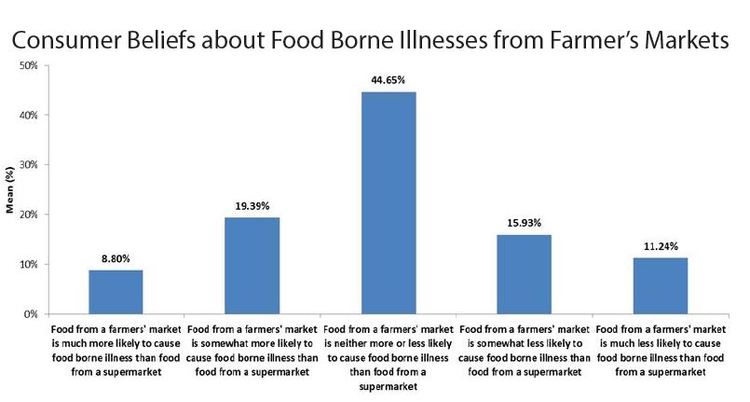
It is nice to finally have some light on this topic, and I am grateful to Jayson for asking that question, because my coauthor and I can now point to Jayson’s survey to argue that the overall effect of consumer perceptions regarding the safety of farmers market foods relative to food from other sources is unlikely to introduce reverse causality, given that the expectation appears to be zero in the above histogram.
[…] Source: marcfbellemare.com […]
Unless of course only one part of that histogram actually go to farmers markets…
Also, one other mechanism for the potential reverse causality that I can think of is the potential that consumers may be less careful about cleaning veggies and fruits that they preventive to be coming from a safer source. A bit of a stretch but it was the first thing that came to mind for me when you said reverse causality.
Actually Emilia, one of the biggest things most people don’t know about food safety is that in most cases, the problem is due to consumer mishandling, not to bad food per se. In the case of farmers markets, it is entirely possible that people are less careful than with supermarket foods.
Marc,
I remember coming across an article that showed that, when it comes to meat, organic markets are the safest, followed by conventional supermarkets, and then farmers markets. I wish I could remember the title but I believe Jayson might be aware of it too.
I’m actually surprised that people think farmer’s markets might be safer. There is so much nonverifiability that I would imagine there is more scope for shady operators. I think one of the LA newstations discovered that there was like 25% fraud at farmer’s markets.