From an article that appeared in the New York Times on Thursday:
“When the American government, a generous and close friend to Uganda, began an organic-farming program to help rural economies here, Mr. Acope expanded, selling a wide variety of commodities at good rates.
His one acre became seven. Mr. Acope fathered 11 children. Uganda was developing, and Mr. Acope was one of many who were riding high, he said.
But the very next year came winds of change. Faced with unrelenting malaria, which threatened both lives and livelihoods, Uganda’s government teamed up with the United States to use chemical insecticide sprays — including DDT — to try to eliminate the disease. Mr. Acope’s home district, Apac, which has some of the highest malaria rates in the world was chosen for spraying in early 2008.”
Let me be completely honest here: This type of lazily-thought-through sob story is the very reason why, at the end of my tenure as editor of the student newspaper of the Université de Montréal in 1998, I decided to get as far away from journalism as I possibly could to go to graduate school in economics instead.
Leaving aside for a second the fact that the poverty-reduction claims of organic farming might not be all that they are cracked up to be, my coauthor Zack Brown just defended his dissertation, and in one of the chapters in his dissertation, he finds that the willingness to pay of households for DDT spraying is positive and represents a significant percentage of their income on the basis of a field experiment. In Uganda.
More importantly, as Cyrus Samii put it to me over Twitter:
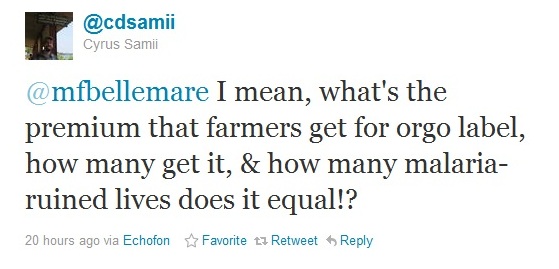
Exactly. What we get is the story of one man who lost his livelihood. But how about the benefits of DDT spraying policies?
Look, I understand that the New York Times is not the Journal of Policy Analysis and Management, but how difficult is it to think in terms of both costs and benefits?
I have to disagree with you on this hypercritical post. The article suffers from being far too short to adequately address the many complex issues it raises — such as how and why it is that the US simultaneously pursues contradictory interventions, or how it could be acceptable to spray DDT, a banned chemical in the US, on African villages, or, as you point out, whether organic farming is really a profitable enterprise for Ugandan farmers — but it does touch on several of them.
It does emphasize the health dangers and economic burdens attributable to malaria, and therefore, by extension, the benefits of DDT spraying policies:
“Many of his friends died from bouts of malaria, a scourge that has plagued this agrarian society.”
and
“Mr. Acope’s home district, Apac, which has some of the highest malaria rates in the world…”
and
“Still, the risks of not spraying are clear as well. In Africa, malaria kills 2,000 children each day, according to Unicef, and costs approximately $12.5 billion in lost incomes each year, the Malaria Consortium says.
and
“It really affects the whole fabric of the economic system in Africa,” said Dr. Patrick Lukulay, a consultant to a United States Agency for International Development initiative to treat malaria. “It prevents people from being productive citizens.”
and
“But given the prevalence of the disease, “chemical spraying with strict monitoring and supervision is one of the most effective measures to control malaria in high-risk areas,” said a United States Embassy official, who was not authorized to speak publicly.”
The piece is a typical daily newspaper story. It focuses on the tip of the iceberg, the news about the lawsuit, and only alludes to everything under the water line. It humanizes the story by focusing on Mr. Acope’s complaints. That’s the nature of the medium.
“Look, I understand that the New York Times is not the Journal of Policy Analysis and Management, but how difficult is it to think in terms of both costs and benefits?”
For journalists? Very, very difficult.
Is this really two conflicting interventions in conflict or simply poor coordination and a failure to consult with local communities? I don’t understand why it has to be an either/or, but this sort of problem seems to happen all the time with top-down interventions.
Surely, had there been better communication before hand, if the people in the local communities, or their agricultural extension officers had been advised of the spraying, that steps or measures could have been taken to accommodate the farmers concerns at the same time as pursuing effective malaria control.