I wish I’d had a chance to write on this topic earlier, but travel to the West Coast for work last week and working on my research this week prevented me from taking the necessary time to read everything I could find on food prices, digest it all, and write something worth reading on the topic.
The crop season started out nicely this spring, with corn producers setting out to cultivate almost 100 million of acres of corn, the largest cultivated area in 75 years. At the beginning of summer, however, things took a turn for the worst, with many areas experiencing both drought and extreme temperature.
Worry about Extreme Temperatures, Not Drought
Before anything else, I’d like to make one thing clear: Rather than drought, it looks as though it is extreme temperature that is the problem.
Indeed, according to my colleague Mike Roberts at NC State, drought is a poor predictor of crop yields, whereas extreme temperature — defined as the number of days for which temperature exceeds 84.2 degrees Fahrenheit — does a much better job of predicting crop yields.
The impact of temperature on crop yields looks like this (see the original research article here):
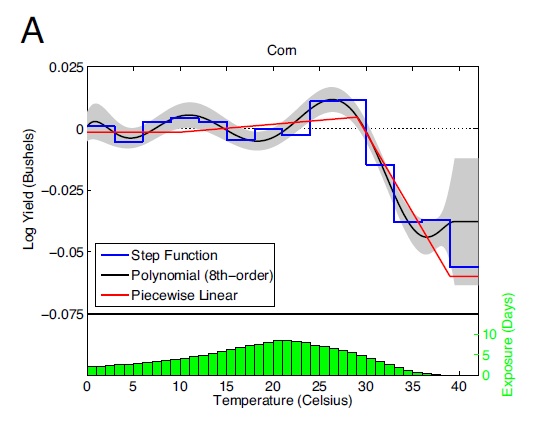
In other words, though there is a roughly linear relationship between temperature and corn yields from about 10 to about 29 degrees Celsius (i.e., from about 50 to about 84.2 degrees Fahrenheit), at which point corn yields drop sharply.
Attacks on Academia in America
There is a terrifying trend in this country right now of attacking academia, specifically, and free thought and intellectualism, generally. Free thought is painted as subversive, dangerous, elitist, and (strangely) conspiratorial. (That word… I do not think it means what you think it means.) Universities are accused of inefficiency and professors of becoming deadwood after tenure or of somehow “subverting the youth”. (Socrates’s accusers made a similar claim before they poisoned one of the great thinkers of the human race.) Politicians attack science to score points with religious fundamentalists and corporate sponsors.
Some elements of these feelings have always floated through the United States psyche, but in recent years it has risen to the level of a festering, suppurating, gangrenous wound in the zeitgeist of the country. Perhaps those who sling accusations at education have forgotten that the US reshaped millennia of social and economic inequity by leading the way in creating public education in the nineteenth century? Or that education has underlaid the majority of the things that have made this country great — fields in which we have led the world? Art, music, literature, political philosophy, architecture, engineering, science, mathematics, medicine, and many others? That the largest economy in the world rests on (educated) innovation, and that the most powerful military in human history is enabled by technological and engineering fruits of the educational system? That the very bones of the United States — the constitution we claim to hold so dear — was crafted by highly educated political idealists of the Enlightenment, who firmly believed that freedom and a more just society are possible only through the actions of an enlightened and educated population of voters?
From an exellent blog post by the University of New Mexico’s Terran Lane explaining why he is leaving academia for the private sector. I’ve quoted the best excerpt, but really, the whole thing is worth reading.
(HT: Andreas Ortmann, via Facebook.)