Skip to content

Marc F. Bellemare Posts

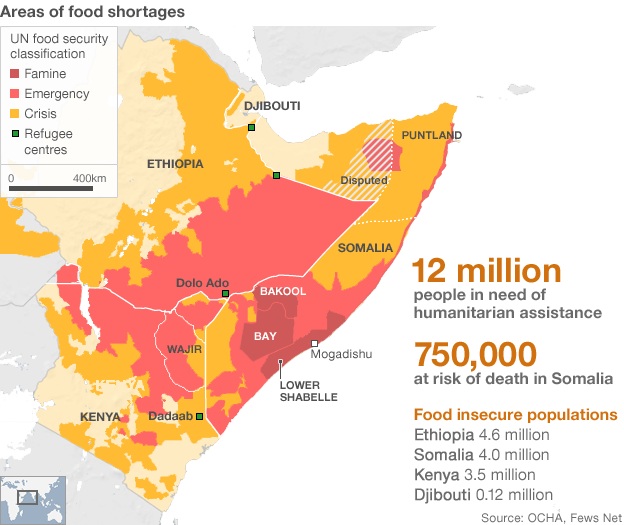
Horn of Africa: Famine Is Not Going Away, Still Appears Man-Made

Image Credit: BBC.

From a BBC news article:

Three months after famine was declared in Somalia, the scale of the crisis in the Horn of Africa remains huge, says a British official.

International Development Secretary Andrew Mitchell said hundreds of people, mainly children, were dying every day.

The coming rainy season is expected to bring disease to crowded refugee camps.

In Somalia alone, Mr Mitchell points out, more than 400,000 children remain at risk of death.

While the rains can bring more misery and death in their wake, they can of course be part of the recovery from this disaster too.

What I find puzzling is the title of the article: “East Africa Drought ‘Remains Huge Crisis’.”

Sure enough, the drought in East Africa is the worst in over 50 years. But to blame it for the famine is a huge stretch. After all, many other areas of the world have experienced drought in the past without then experiencing famine.

More convincingly, why is it that Somalia is experiencing famine, but that Kenya and Ethiopia are not? The different institutions on either side of the Kenya-Somalia and the Ethiopia-Somalia borders make for a nice social experiment and point to the idea that famines are man-made.

In other words, while natural disasters can certainly cause food shortages, it really looks as though bad institutions — the lack of government accountability in most cases — are really the root cause of famine.

For more on the current famine in the Horn of Africa and its human causes, I encourage readers to listen to this excellent podcast.

The Causes and Consequences of Food Price Volatility

From a longer IRIN article published last week:

Recent responses to high prices have increasingly tended to focus on reducing price volatility — sharp fluctuations in food prices.

G20 countries in their June 2011 ministerial declaration recommended measures such as building grain reserves, a global market information system and regulating financial transactions in commodities markets.

But economists like Brian Wright, professor of agricultural and resource economics at the University of California, Berkeley, and Christopher Barrett, professor of applied economics at Cornell University, believe more emphasis needs to be placed on underlying policy problems.

“Volatility is a symptom of a structural problem of low stocks,” says Wright. “When supplies get to certain low levels the prices become vulnerable to volatility.”

He makes a distinction between the impact of one-off production shortfalls and low grain stocks over a longer period: “Though [price] spikes do not indicate times of large aggregate food grain production shortfalls, it is easy to check that they do indicate times when aggregate stocks were low.”

Barrett would like to see more emphasis on boosting production and improving distribution systems to increase the supply of food and bring down prices. “Food price volatility gets addressed naturally as food supplies expand, bringing down prices and encouraging expansion of price-stabilizing inventories.”

Traditional policy responses to price volatility tend to benefit large farmers in developed countries and not the poor consumer or producer in a developing country, said Barrett.

“Every dollar spent on developing expensive reserves or marketing systems is a dollar taken away from improving yields, from developing drought-tolerant rice or setting up marketing infrastructure in a developing country,” he said.


Earthquake in Turkey: Where to Give (Updated)

A 7.2-magnitude earthquake hit Eastern Turkey today. You can read the the LA Times‘ account here. As of writing, 60 89 138 217 people are confirmed dead, but as many as 1,000 people may have died.

How and where to donate? Here is how you can contribute:

  • If you are in the US, you can text GIVE TURKEY to 80088 to automatically donate $10 to Global Giving’s Turkey Earthquake Relief Fund. Message and data rates may apply. Their terms of service are here.
  • You can also visit Global Giving’s Turkey Earthquake Relief Fund directly by clicking here.

UPDATE: On Yahoo! Answers, someone has questioned the legitimacy of this blog post or of Global Giving. Just so everyone knows: I am not getting anything out of this (other than the knowledge that I have provided a way for people to contribute and, of course, page views). And if you want to know more about Global Giving, see the Wiki entry here, and see the SourceWatch entry here.

I don’t know if the International Committee of the Red Cross will set up an option to give directly for Turkey over the coming few days. If they do, they are always a good option.

I’m sure there are many other good options. Please feel free to link to them in the comments.

UPDATE: And just to show that I put my money where my mouth is, here is a screen capture of the receipt for my own donation (click on the picture to see it in a readable size):