I had been meaning to introduce this new environmental economics blog, courtesy of my colleague Lori Bennear, who is an Assistant Professor in the Nicholas School of the Environment here at Duke.
In one of her first posts, Lori looks at the externalities from fracking in relation to the Coase Theorem:
There are many potential externalities associated with fracking. An excellent analysis of potential externalities from methane contamination of groundwater by Osborn, Vengosh, Warner, and Jackson, all from Duke, can be found in this paper. Today’s blog will focus on a different aspect of the fracking debate — the negative externalities associated with radioactive wastewater.
You read that right: Eye disease and development. I was intrigued when I saw that it was the title of a new working paper (the link opens a .pdf document) on the NEP-DEV mailing list. After reading the abstract, the title made a lot more sense:
This research advances the hypothesis that cross-country variation in the historical incidence of eye disease has influenced the current global distribution of per capita income. The theory is that pervasive eye disease diminished the incentive to accumulate skills, thereby delaying the
fertility transition and the take-off to sustained economic growth. In order to estimate the influence from eye disease incidence empirically, we draw on an important fact from the field of epidemiology: Exposure to solar ultraviolet B radiation (UVB-R) is an underlying determinant of several forms of eye disease; the most important being cataract, which is currently the leading cause of blindness worldwide. Using a satellite-based measure of UVB-R, we document that societies more exposed to UVB-R are poorer and underwent the fertility transition with a significant delay compared to the forerunners. These findings are robust to the inclusion of an extensive set of climate and geography controls. Moreover, using a global data set on economic activity for all terrestrial grid cells we show that the link between UVB-R and economic development survives the inclusion of country fixed effect.
I have not had a chance to read the paper yet, but I wonder just how unpredictable UVB-R is within a given society, and so whether it is truly exogenous to economic growth. This is a compelling finding nevertheless.
I flew out to California last Thursday night to work with coauthors over the weekend and give a talk on Monday.
My laptop worked just fine when I went to bed on Thursday night. But when I woke up on Friday morning and wanted to check email, my laptop just wouldn’t start.
This was going to be a long, unproductive weekend.
That is, until I ran a Google search for “lenovo t400 died when not plugged in” on my phone. I didn’t expect to find anything helpful, but the second link had an interesting enough title — “The Secret Thinkpad Power Button Code to Bring Dead Laptops Back to Life” — that I decided to check it out.
Here is what Mike Masnick, who runs the famous Techdirt blog, had posted on his personal blog in 2007:
I knew something was wrong when the “sleep” light wasn’t lit. I started to get worried when I plugged in the laptop and the battery light didn’t light up. Then I noticed that even though the machine had been asleep, it was really really hot. Pushing the power button did nothing. No lights were on and nothing seemed to get them to turn on. I pulled out the battery and put it back in and that did nothing as well.
So I called up IBM support and explained the situation. The guy on the other end then let me in on the secret power button code to revive your dead Thinkpad. After assessing the situation (totally dead laptop) he warned me: “Okay, this is going to sound totally bizarre, but I want you to give this a try…” He then had me unplug the AC adapter and take out the battery. Then, you push the power button 10 times in a row at one second intervals. Next, you push and hold the power button for 30 seconds. Then you put the battery back in and push the power button… and she lives. The computer came back, good as ever.
I asked the guy what the power button pushing incantation did and he said “static discharge” so apparently there was some sort of static that caused a short or something. I tried to get the guy to explain in more detail what happened, but he said “dude, you know as much as I do… but your machine is working.”
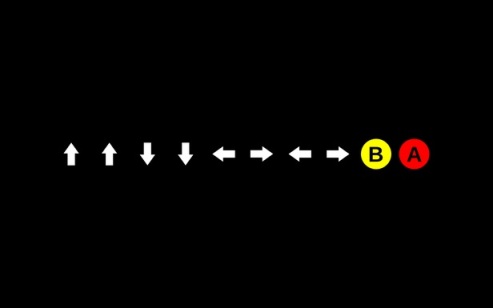
Readers from my generation probably remember the Konami code of yore, a cheat code — up, up, down, down, left, right, left, right, B, A, Start — one had to enter on the start screen of some Konami games to get more lives. Who knew there would be such a code to literally get an extra life for my laptop?