Skip to content

Marc F. Bellemare Posts

Hunger and Conflict

An interesting map showing the risk of food insecurity on Damian Carrington’s blog on The Guardian’s website:
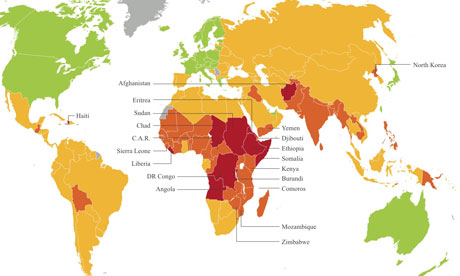


As you may have guessed, green denotes areas where there is a low risk of food insecurity, whereas red denotes areas where there is an extreme risk of food insecurity. Of course, the dark orange and red areas coincide with countries that are often subject to conflict, civil or otherwise. Carrington writes:

And it demonstrates the sickening, symbiotic relationship between lack of food and conflict: where one leads, the other follows.

We must start with the worst, in the horn of Africa. In Somalia, Ethiopia and Eritrea, human failings mean a severe drought has tipped millions into famine. It’s a textbook case of why things go wrong. War begets poverty, leaving food unaffordable. Devastated infrastructure destroys both food production and the ability to truck in emergency food. The collapse of society means the effects of extreme weather such as drought cannot be dealt with. And the fear of violence turns people into refugees, leaving their livelihoods and social networks behind.

To which I say: Let’s not get carried away. The map shows a correlation, but correlation does not imply causation. As such, the map demonstrates nothing except for the fact that there is a potentially statistically significant correlation between hunger and conflict.

For a (hopefully) more convincing argument that actually aims at establishing that there is indeed a causal relationship flowing from food prices to social unrest, see here.

(HT: @viewfromthecave.)

Want to Teach Writing at Duke?

The Thompson Writing Program at Duke is looking for lecturing fellows:

Lecturing Fellows, Thompson Writing Program, Duke University

We anticipate offering several postdoctoral fellowships on a multidisciplinary faculty charged with teaching an innovative first-year course in Academic Writing.  We seek candidates with a PhD in any field and a demonstrated commitment to undergraduate teaching.

Fellows are asked to draw on their disciplinary training and interests to design a seminar-style course introducing students to academic writing.  Teaching load is five sections of Academic Writing per year, with each section limited to 12 students.

Appointment is at a level of Lecturing Fellow (non-tenure-track) starting July 1, 2012.  Contract is for an initial three years, renewable after successful review for two more years.  Salary is competitive with a strong benefits package, and with opportunities for professional development.

To apply use our online application form at  http://twp.duke.edu/fellowships. Send us your curriculum vitae, a letter in which you discuss your aims in teaching Academic Writing, a brief proposal for a writing seminar modeled on course synopses posted on our website at http://twp.duke.edu/writing-20.

We may subsequently ask you to provide other supporting materials, including a more detailed course outline, and teaching materials.  If you are unable to apply online, you may mail hard copies to

Denise Comer

Chair, Lecturing Fellows Search,

Thompson Writing Program

Duke University

Box 90025

Durham, NC 27708-0025

Applications received by 11:59 PM EST (Eastern Standard Time) October 15, 2011, will be guaranteed consideration.  Duke is an Affirmative Action/Equal Opportunity Employer. Women and minorities are strongly encouraged to apply.

 (HT: @seenfromafar.)

Migration to Stimulate the Global Economy?

I have long believed that immigration is the key to our fiscal woes. The only way Americans will be able to afford and enjoy programs like Social Security and Medicare in the future (i.e., when the baby boom generation retires and there are relatively fewer workers to pay for social programs) is to allow would-be workers into the country so they can work (and stimulate demand) and pay taxes.

post by the Center for Global Development’s Michael Clemens on the Guardian‘s Poverty Matters blog makes a broader point: