Last updated on November 13, 2011
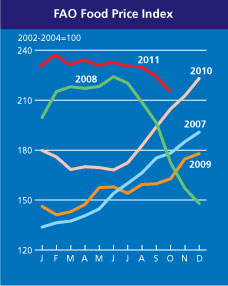
From the Food and Agriculture Organization (FAO) of the United Nations comes much-needed good news on the food prices front:
The food price index averaged 216 points in October 2011, down 4 percent, or as much as 9 points, from September and 22 points, or 9 percent, below its peak of 238 points reached in February 2011. The index has been falling steadily since June and, in October, dropped to an 11-month low, but still some 5 percent above the corresponding period last year. The decline reflects sharp decreases in international prices of all the commodities included in the index.
Indeed, the food price index encompasses five food categories: cereals, oils and fats, meat, dairy, and sugar. The real good news is that the price of cereals — which constitute the bulk of the diet of the poor in developing countries — has also declined significantly:
The cereal price index averaged 232 points in October, down 5 percent, or 13 points, from September, 15 percent below its peak in April 2008, though 5 percent, or 12 points, higher than in October 2010. The continuing decline in the monthly value of the cereal price index reflects this year’s prospect for a strong production recovery and slow economic growth in many developed countries weighing on overall demand, particularly from the feed and biofuels sectors.
We should also expect a decline in social unrest throughout the world as a consequences of lower food prices (link opens a .pdf document).
Good news indeed — but let’s hope it does not become an excuse for inaction (or inappropriate action)!
Thanks for your comment, Doug. I agree that some may this as an excuse for inaction, but I think what we need to figure out next is the causes of rising food prices so as to prevent them from happening. But tell me: Do you still believe Oxfam’s prediction that food prices will double by 2030?
I thought the cause of rising food prices was reduced supply, or possibly in some cases the expectation of reduced supply. Have I got this wrong?
I just reread the post a few times. What in it leads you to believe that you have your reasoning wrong? The prospect of a strong production recovery means an expected increase in supply, and so lower prices, everything else equal. Likewise, slow economic growth means a decrease in the quantity demand, and lower prices yet again, everything else equal.
Hey Marc, on causes, you don’t think we already know most of the reasons? Namely, increased meat (and therefore grain and other inputs) consumption and biofuels (including almost 40% of US corn). Going forward prices will likely also rise as we move past peak soil and oil and water, and possibly even shift the farm bill subsidy structure in the US – while, in the meantime, our and EU subsidies are forcing peasant farmers in the global South of their land, since we undercut the prices they need with taxpayer money. Even if we do change subsidies, there will be a production lag even if there is a push to return to agriculture. Though, regardless of prices, we have a distribution problem. As Raj Patel puts it in his book title, Stuffed & Starved.
Christine! Thanks for reading me. Let me put on my applied microeconomist’s hat, here: I think we have a good idea of the correlations, but we have very little causal evidence as to what drives food prices. Kind of like we used to have a good idea that charging for bednets decreased the demand, but didn’t really have actual causal evidence until recently. I am agnostic about what will happen to food prices in the future, but I wouldn’t be willing to bet on them rising consistently. You and I agree, however, on the need to eliminate farm subsidies in developed economies. P.S.: Say hi to Felix!
I’m more of an epidemiologist. When you have time order plus correlation, that is much stronger evidence than simply correlation. Especially when other (hypothetical or known) potential causes did not change meaningfully in that time frame. Though I’ve also heard arguments about futures markets speculators. That requires an economist hat, which I never wear. (Speaking of economists, he says hi, and also pointed to speculation.)