Skip to content

Marc F. Bellemare Posts

Messing with Markets: Raisin Hell

Since the 1940s raisin farmers have been obliged to make over a portion of their crop to a government agency called the Raisin Administrative Committee. The committee, run by 47 raisin farmers and packers, along with a sole member of the raisin-eating public, decides each year how many raisins the domestic market can bear, and thus how many it should siphon off to preserve an “orderly” market. It does not pay for the raisins it appropriates, and gives many of them away, while selling others for export. Once it has covered its own costs, it returns whatever profits remain to farmers. In some years there are none. Worse, farmers sometimes forfeit a substantial share of their crop: 47% in 2003 and 30% in 2004, for example.

Participation in this Brezhnevite scheme is mandatory. Although a large majority of raisin farmers approved of it by referendum when it started 65 years ago, they have not been formally consulted since. And raisins are just one of 30 products subject to such “marketing orders” overseen by the Department of Agriculture.

From an article in this week’s edition of The Economist.

Since the 1940s? Thirty such marketing orders? I wonder why the asinine crowd who usually delights in braying “Socialiss’!” in this country hasn’t made itself heard on this matter yet.

More on British vs. French Colonial Institutions

An email from Chuhang Yin, a former student of mine:

I just read your newest blog post and I am fascinated by this topic. I found a recent [Quarterly Journal of Political Science] paper by Alexander Lee and Kenneth Schultz at Stanford titled “Comparing British and French Colonial Legacies: A Discontinuity Analysis of Cameroon” and think it might be relevant. Their focus is on public goods and individual wealth, but not on land productivity. The abstract is here:

“Colonial institutions are thought to be an important determinate of post-independence levels of political stability, economic growth, and public goods provision. In particular, many scholars have suggested that British institutional and cultural legacies are more conducive to growth than those of France or other colonizers. Systematic tests of this hypothesis are complicated by unobserved heterogeneity among nations due to variable pre- and post-colonial histories. We focus on the West African nation of Cameroon, which includes regions colonized by both Britain and France, and use the artificial former colonial boundary as a discontinuity within a national demographic survey. We show that rural areas on the British side of discontinuity have higher levels of household wealth and local public provision of piped water. Results for urban areas and centrally-provided public goods show no such effect, suggesting that post-independence policies also play a role in shaping outcomes.”

Specifically about results:

“Using data from the 2004 Demographic and Health Survey of Cameroon, we compare communities near the former colonial border using both a regression discontinuity research design and a comparison of neighboring villages that straddle the boundary. We show that rural households on the British side have higher levels of wealth and are more likely to have access to piped water, a locally provided public good. These results do not hold for urban areas or for centrally-provided public goods like roads and education, suggesting that the effect of colonial-era differences can be attenuated by post-colonial policies.”

I also found a paper published in 2000 in Comparative Politics titled “Institutions, Context, and Outcomes: Explaining French and British Rule in West Africa” which might also be useful:

“I seek to solve this puzzle by tracing the origin of class formation in Ivory Coast’s and Ghana’s rural areas. Specifically, French and British colonial institutions generated different property rights and landholding patterns, forming the basis for different patterns of class formation.”

On page 258 to 260 the author discusses the differences of British and French institutions.

Not Worth the Paper They Are Printed On

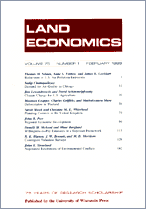
LandEconomicsLand Economics has now published my article on the productivity impacts of land rights in Madagascar, which is creatively titled “The Productivity Impacts of Formal and Informal Land Rights: Evidence from Madagascar.”

Here’s the abstract:

This paper studies the relationship between land rights and agricultural productivity. Whereas previous studies used proxies for soil quality and instrumental variables to control for the endogeneity of land titles, the data used here include precise soil quality measurements, which in principle allow controlling for the unobserved heterogeneity between plots. Empirical results suggest that formal land rights (i.e., land titles) have no impact on productivity, but that informal land rights (i.e., landowners’ subjective perceptions of what they can and cannot do with their plots) have heterogeneous impacts on productivity.

In other words, what I find is that no matter how you slice the data, land rights do not appear to have the beneficial effect many people seem to think they have. The emphasis is mine, for reasons that are perhaps best explained in the last paragraph of the paper:

[T]he US government’s Millennium Challenge Corporation signed a $110 million, four-year compact with the government of Madagascar in 2005 which included an important land tenure component, and whose goal was to “increase land titling,” and thus land security (Millennium Challenge Corporation 2010). But in a context where land titles do not seem to have improved agricultural productivity, the finding that land titles do not have such an impact is highly relevant for policy in that it helps knowing where to allocate aid dollars at the margin. Here, it looks as though aid might be better allocated to a reform of the legal framework within which agriculture takes place. Policy should be based on empirical evidence — not theoretical beliefs.

At the end of the day, the land titles in those data appear to be worth no more than the paper they are printed on.

What’s interesting to me about these findings, in light of my evolving research interests, is that many others find that land rights have beneficial effects on productivity. Generally speaking, however, it looks as though those beneficial effects of land titles are found in former British colonies in Africa. In former French colonies such as Madagascar, however, it looks as though land titles have no impact. This brings to mind a passage from Herbst’s States and Power in Africa:

France was notable for its unusually unsuccessful efforts to disrupt customary tenure during the colonial period, despite its sweeping laws that theoretically made wholesale changes in land tenure (…) France relied on administrative fiat to try to change customary tenure procedures.

Does anyone know of a study looking at the differential approaches to or impacts of British vs. French colonial institutions dealing with land tenure issues? I think there would be a neat paper to be written on that.