Skip to content

Marc F. Bellemare Posts

On the DFAIT–CIDA Merger

CIDA

As part of its 2013 budget, the Harper government has decided to fold the Canadian International Development Agency (CIDA) into the Department of Foreign Affairs and International Trade (DFAIT).

It is not uncommon for a developed country to have its development agency depend directly on its ministry of foreign affairs. In the United States, for example, the US Agency for International Development depends on the State Department. In France, the Agence française de développement depends on the Quai d’Orsay.
GardnerTweet

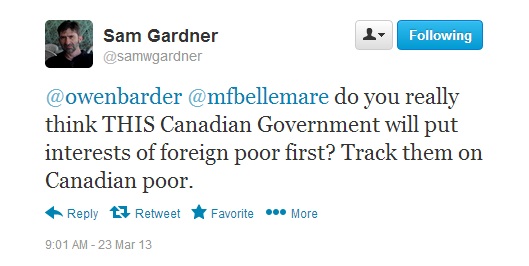
Many in Canada were up in arms about the DFAIT–CIDA merger. I suspect that reactions would have been very different had this merger taken place under a different (i.e., not Conservative) government: the Zeitgeist in Quebec, Ontario, and British Columbia is that nothing the Harper government does is ever right. (This isn’t to say I support the Harper government; those who know me well also know that I have spent two summers working for a Liberal cabinet minister when I was in college.)

I was given the chance to express my view on the merger in a Toronto Star article by Rick Westhead:

“We wish foreign aid was altruistic, but it’s always been an expression of foreign policy,” said David Morley, president of UNICEF’s Canadian operations. “Sometimes you felt the two (CIDA and Foreign Affairs) were going off into different worlds. This could be good, getting the aid portfolio closer to power.”

“Canada doesn’t do aid out of generosity or good nature,” said Marc Bellemare, a Quebec native and assistant economics professor at Duke University who studies development assistance. “Aid has always been tied to foreign policy. This is more transparent. At least we’re being more open about what it is.”

The story features the views of many other people, who have much smarter things to say than I do about the whole thing. Owen Barder, for example, notes that having development assistance and international trade be part of the same organization may well help Canada have a more consistent stance toward developing-country agriculture, given that most agricultural imports to Canada are slapped with a 19 percent tariff.

Owen also had an op-ed on the topic in The Globe and Mail in which he argues that Canadian development is more than just CIDA.

#OccupySugar and the Political Economy of Farm Subsidies

Right here in America, under our collective nose, there is an industry that survives on political patronage and government subsidies, that regularly receives mysterious and untraceable bailouts funded by taxpayers, that is disproportionately influential in Washington as a result of its massive lobbying efforts, and that is making huge profits at the expense of ordinary consumers.

I’m not talking about Wall Street. I’m talking about the American sugar industry, which for years has been a perfect case study for the corrupting influence of money in politics. …

Today’s Wall Street Journal has a story about the Department of Agriculture’s decision to consider bailing out the U.S. sugar industry by buying 400,000 tons of sugar from major U.S. producers, at a taxpayer-funded cost of roughly $80 million. …

Why does the U.S. sugar industry need an $80 million bailout, you ask? Because sugar-makers are in danger of defaulting on loans the government gave them as part of a previous bailout program.

That’s from a very interesting article published a few weeks ago in New York magazine which discusses the political economy of agricultural subsidies in the United States.

The article was very à propos given that we’d just finished discussing farm subsidies in my food policy seminar.

Why does the sugar sector benefit from such subsidies, which end up costing consumers through both the prices they pay and their tax bill? As we have discussed several times in my seminar, the reason is essentially that it is easier for producers to organize and lobby the government than it is for consumers to do the same.

In The Logic of Collective Action, Olson noted that smaller groups have an easier time organizing than large ones do, and studies have shown that smaller commodity groups such as sugar producers get better subsidies than larger commodity groups such as corn producers.

Therefore, as the agricultural sector declines and the number of farms decreases, lobbying becomes a much better proposition for farmers, and the subsidies get increasingly better. For more on the political economy of farm subsidies (and on the politics of food in general in the US), everyone should read Rob Paarlberg’s Food Politics: What Everyone Should Know.

African Institutions and the Endangered Species Act

From an op-ed I published in the Star Tribune (Minneapolis–St. Paul) this past weekend:

Not only is Tanzania a relatively corrupt country, but researchers also note extensive corruption in the hunting sector. It is for that reason that Tanzania’s minister for natural resources and tourism issued a stern warning to the Tanzania Safari Outfitters Association at a meeting in Dar es Salaam last fall, noting that corruption usually began with wealthy hunters bribing officials so that they would turn a blind eye to illegal behavior.

Instead of lobbying against placing the African lion on the endangered species list, Tanzania should seek to reform its institutions. Not only would this help protect the country’s big-game reserves, it is also a crucial step toward the sustainable development of the Tanzanian economy. A persistent finding in development economics is that dysfunctional institutions, of which corruption is a symptom, are an important cause of underdevelopment.