Taking a page from Hans Rosling, Tufts School of Nutrition associate professor Parke Wilde and his coauthors have developed a fascinating Google Gadget to help visualize the evolution of the Supplemental Nutrition Assistance Program (SNAP), i.e., of the food stamp program. Parke’s post on the topic is here.
The SNAP is one of the US government’s most important programs aimed at helping the poor (and, for those of us who teach principles of microeconomics, it also provides a great in-class example when teaching about budget constraints.)
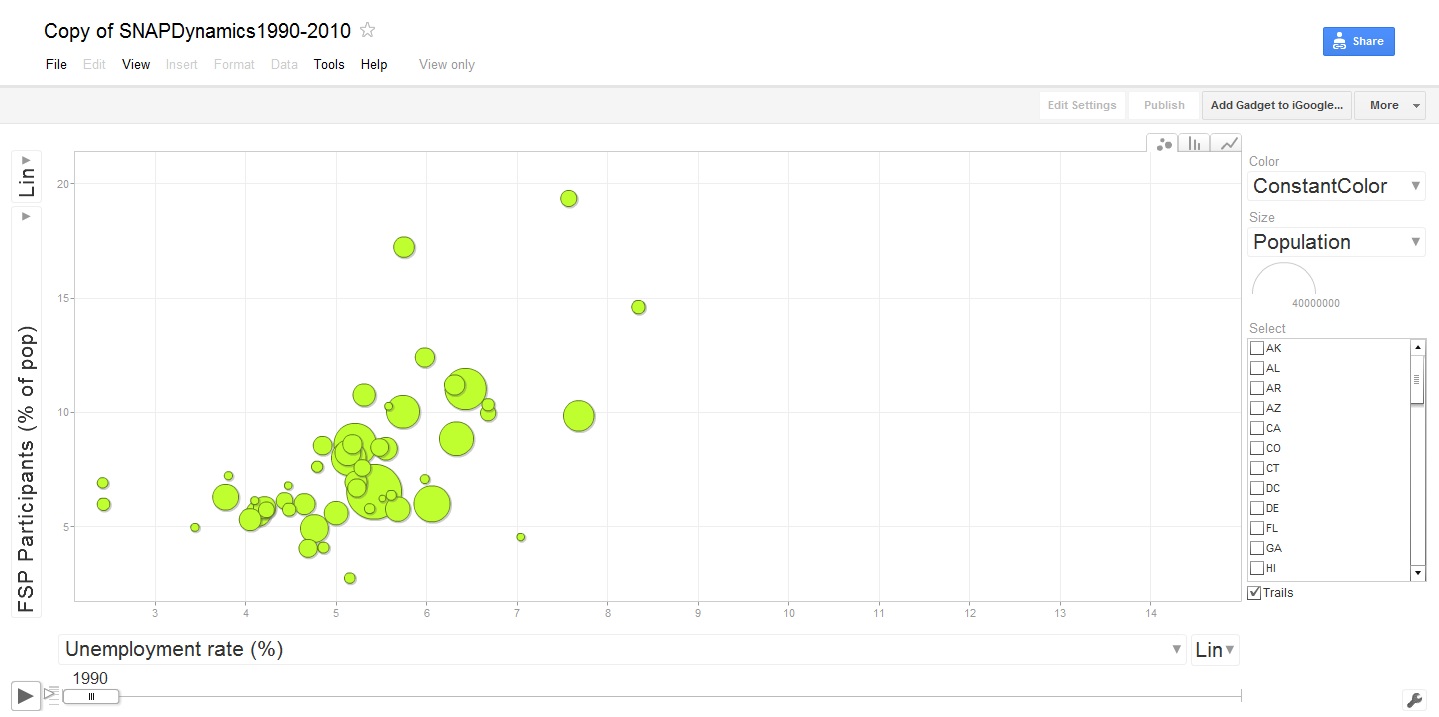 The gadget developed by Parke and his coauthors allows one to track either the number of SNAP participants or the proportion of SNAP participants as a percentage of the population against other indicators — population or unemployment rate — for all 50 states plus the District of Columbia over the last 20 years.
For example, looking at North Carolina where I live, I see that the state went from a proportion of food stamp users of 6.3 percent for an unemployment rate of 3.8 percent in 1990 to a proportion of food stamp users of 14.1 percent for an unemployment rate of 10.9 percent. It is particularly disturbing, however, to watch the proportion of SNAP participants explode after 2008 all over the country.
Seven Billion People on Earth: Enough with the Fear Mongering
The seven billionth person on Earth will be born today according to the United Nations. To mark occasion, the BBC has developed an application that allows calculating your own number. I learned that, of all the people now alive, I was born 4,133,669,462nd.
As is inevitably the case when talking about the world’s population, the birth of the seven billionth person has caused a rash of newspaper articles, newscasts, and blog posts about how this really is a sign that at least two of the Four Horsemen of the Apocalypse — famine and death — will soon be here.
For a perfect example of that type of fear mongering, see this presentation, by Australian journalist Julian Cribb.
The Reverend’s New(est) Clothes
But really, Cribb is merely serving us the reheated leftovers of Reverend Thomas Malthus‘ Essay on the Principle of Population. In this book, first published in 1798, Malthus asserted that disease and famine would naturally arise to limit the size of any population.
Thus, because population growth would outpace agricultural growth (after all, there is only a limited amount of arable land in the world), disease and famine would take care of keeping the size of the population in check. Malthus actually estimated that the upper bound was equal to about one billion.